



If I Move to Mexico, Do I Have to Pay Taxes in Mexico?
You obtain Mexican temporary residency. You rent a home in Querétaro. You open a Mexican bank account. And then comes the uncomfortable question: Does this mean I now have to pay taxes in Mexico?
The answer is not automatically yes—or no. One of the biggest sources of confusion for people moving internationally is that immigration residency and tax residency are two different concepts.
Having a Mexican resident card does not, by itself, answer every tax question. Where you live, where you work, where your income comes from and where your economic and professional life is centered can all matter. Here are some of the questions international families ask most frequently.
Is Mexican Immigration Residency the Same as Tax Residency?
No. Your temporary or permanent resident card is an immigration document issued within Mexico's immigration system. Tax residence (residencia fiscal) is determined under tax law. They are related because moving your life to Mexico can obviously affect your tax situation, but one status does not simply substitute for the other. This distinction is especially important for people who obtain Mexican residency as a future option but continue living and working primarily in another country.
What Makes Someone a Mexican Tax Resident?
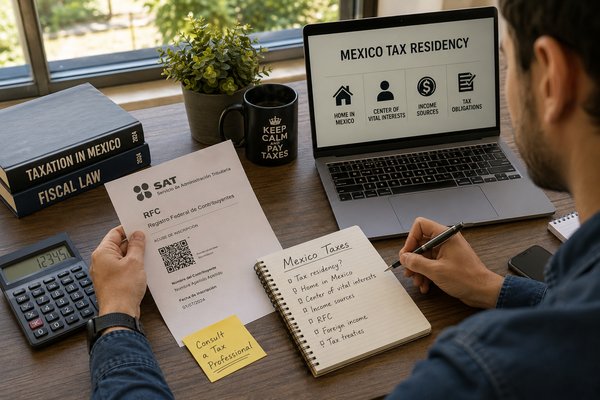
Mexican law considers an individual a Mexican tax resident when that person has established a home in Mexico. But international lives can be complicated. What if you have a house in Mexico and another one in the United States, Canada or elsewhere? Mexican law then looks at your center of vital interests.
Among the factors specifically identified in the Federal Tax Code are whether more than 50% of your total annual income comes from sources in Mexico and whether Mexico is the principal center of your professional activities. That is why simplistic rules such as "You become a tax resident after X days" can be misleading when applied to Mexico. Your individual circumstances matter.
If I'm a Mexican Tax Resident, Does Mexico Tax My Foreign Income?
Potentially, yes. And this is where professional tax advice becomes particularly important. Mexico's Income Tax Law establishes that individuals who are residents of Mexico are subject to Mexican income tax on the income they receive. For someone whose entire financial life is in Mexico, that may be relatively straightforward.
For internationally mobile residents, the picture can involve:
- Salary from a foreign employer.
- Freelance or consulting income.
- Business income.
- Investments.
- Rental properties abroad.
- Pensions.
- Capital gains.
- Income already taxed in another country.
The tax treatment of these categories is not necessarily identical. So "I already paid tax on it abroad" does not automatically mean you can ignore it in Mexico. Tax treaties, foreign tax credits and domestic tax rules may determine how double taxation is prevented.
Tax Residency Does Not Necessarily Mean Taxes to Pay... But It May Mean Tax Obligations
An important distinction is that becoming a Mexican tax resident does not necessarily mean that you will owe Mexican income tax. However, you may still have tax reporting and compliance obligations.
Depending on your income and tax situation, these can include registering or updating your information with the SAT, filing tax returns, reporting certain types of income, and maintaining the appropriate tax status. In many cases, an annual tax return may be required even when the calculation results in no tax due.
What If I Work Remotely for a U.S. or Canadian Company?
This is one of the questions remote workers most frequently misunderstand. Where the company paying you is located is not necessarily the only relevant factor. If you move to Mexico and physically perform your work here, your tax situation may be different from that of someone merely spending a few weeks working from a hotel. Your tax residence, employment relationship, source and type of income, length and nature of your presence in Mexico, and applicable international agreements can all become relevant.
So: "My employer is American, therefore I only pay U.S. taxes" is not a safe assumption.
This is precisely the kind of situation where an accountant familiar with cross-border taxation is preferable to relying on general advice from an expat forum.
What Is an RFC?
The RFC — Registro Federal de Contribuyentes — is Mexico's federal taxpayer identification system. A useful comparison for Americans is a tax identification number, although the systems are not identical.
Foreigners can obtain an RFC, and SAT (Mexico's equivalent to the IRS) specifically provides procedures for foreign individuals who need to register. Its current requirements include a valid immigration document and proof of address, depending on the applicable registration procedure.
But here's another important distinction: Having an RFC does not necessarily mean that you owe income tax. Your RFC identifies you within Mexico's fiscal system. Your actual tax obligations depend on your activities and fiscal situation.
Why Would I Need an RFC If I'm Not Working in Mexico?
Because the RFC has become useful far beyond simply filing an income tax return. As newcomers establish themselves in Mexico, they may encounter it in financial, employment, property and other administrative processes (for example, you need one to open an account in most banks). That is why obtaining an RFC often becomes part of the practical settling-in process, even for residents whose situation is relatively simple.
The important thing is not merely obtaining the number. It is making sure your registration accurately reflects your actual fiscal situation.
What About Retirees?
Retirement does not automatically make taxes irrelevant. A retiree might receive Social Security, a private pension, retirement-account distributions, investment income, rental income or several of these simultaneously. The country from which the money originates and the person's tax residence can both matter. International tax treaties may also affect the treatment of particular types of income.
For retirees with income from another country, getting professional advice before establishing tax residence in Mexico can be much easier than trying to restructure things afterward.
I'm American. Don't I Still Have to File U.S. Taxes?
Generally, yes. This is one of the most important differences affecting U.S. citizens abroad. The IRS states that U.S. citizens and resident aliens are generally subject to U.S. income tax on their worldwide income regardless of where they live. Moving to Mexico therefore does not normally make U.S. filing obligations simply disappear. But that doesn't necessarily mean paying the full amount of tax twice.
The United States and Mexico have an income tax treaty, and mechanisms such as foreign tax credits can help provide relief from double taxation in applicable situations. The treaty expressly includes provisions addressing relief from double taxation. For U.S. citizens who become Mexican tax residents, having an accountant who understands both systems can be particularly valuable.
Can I Be Considered a Tax Resident by Two Countries?
It can happen that domestic laws initially create competing claims of residence. That's one reason tax treaties exist. Treaties may contain rules for determining how residence and taxing rights are treated when both countries' systems are involved. But this is not something to resolve by choosing whichever country has the lower tax rate. It requires looking at the relevant domestic laws, treaty provisions and the person's actual circumstances.
If I Buy a House in Mexico, Do I Automatically Become a Tax Resident?
Not necessarily. Owning property and establishing your home for tax-residency purposes are not automatically identical questions. Foreign residents can also have Mexican tax obligations arising from Mexican-source income even when they are not Mexican tax residents. SAT explicitly notes that residents abroad may owe Mexican tax when they receive income from a source of wealth located in Mexico. Property can therefore have tax consequences without automatically resolving the broader question of your fiscal residence.
What If I'm Only Renting?
Renting rather than buying does not automatically keep someone outside Mexican tax residency either. Tax residence is about the reality of where your home and economic life are established—not simply whose name appears on the property deed. This is why two foreigners with identical temporary-resident cards can have very different tax situations.
One may live primarily abroad and visit Mexico periodically. The other may live in Querétaro year-round, operate a business here and conduct most of their professional activities from Mexico. Their immigration cards might look identical. Their tax circumstances may not.
When Should I Talk to an Accountant?
Ideally, before the move if your financial situation crosses borders.
Professional advice becomes particularly important if you:
- Continue working for a foreign employer.
- Own a company abroad.
- Work independently for foreign clients.
- Have substantial investments.
- Receive pension or retirement income.
- Own rental properties outside Mexico.
- Have homes in more than one country.
- Are a U.S. citizen with continuing U.S. filing obligations.
- Expect to spend most of the year in Mexico.
- Are unsure where your center of vital interests will be.
A consultation before relocating can identify issues while you still have time to plan.
The Bigger Picture: Moving Countries Can Change More Than Your Address
A good relocation plan isn't simply: Get residency → rent a house → move to Mexico.
For people with international income, it should look more like:
Understand immigration status → evaluate tax residency → review foreign income → determine RFC requirements → understand obligations in your home country → identify treaty implications → obtain professional advice when necessary → relocate with a clear plan.
None of this means moving to Mexico necessarily creates a large new tax burden. It means you shouldn't assume that immigration status, physical residence and tax residence are all the same thing. They aren't.
Where Nexterra Comes In
At Nexterra, we help international families manage the practical steps involved in establishing their lives in Querétaro, including immigration, housing and settling-in processes such as obtaining an RFC.
We don't replace professional tax or accounting advice. When your situation requires specialized fiscal guidance, the objective is to recognize that need early and coordinate the right professionals as part of the relocation process. What we can do is refer you to such professionar tax guidance with our network of experts. Because a successful international move isn't only about getting here. It's about understanding what changes once you do.